

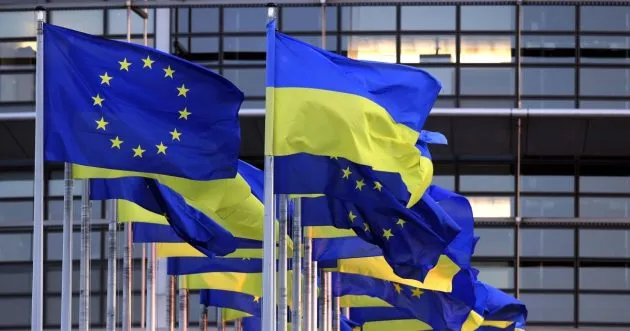
Before the scheduled meeting between U.S. President Donald Trump and Russian President Vladimir Putin, the leaders of the European Union issued a joint statement regarding Ukraine. The document emphasizes that peace in Ukraine is impossible without Ukraine’s participation in the negotiations, and reaffirms commitment to the principles of international law and support for the territorial integrity of the Ukrainian state. However, Hungary refused to support this statement.
This is reported by Kyiv24
EU Statement: Support for Ukraine’s Sovereignty and Security
European leaders stressed that a stable and just peace must be based on adherence to international law, including the principles of independence, sovereignty, and territorial integrity. Special attention was given to the fact that the people of Ukraine must determine their own future. The statement also noted that real negotiations are only possible if there is a ceasefire or a significant reduction in hostilities, and any diplomatic resolution must take into account the key security interests of Ukraine and Europe.
“A just and lasting peace that brings stability and security must respect international law, including the principles of independence, sovereignty, territorial integrity, and the inviolability of international borders that cannot be changed by force. The people of Ukraine must have the freedom to determine their own future,” the statement reads.
The document emphasizes that a Ukraine capable of defending itself is a key element of future security guarantees, and that the EU and its member states will continue to contribute to ensuring Ukraine’s security. The European Union promised to continue providing political, financial, economic, humanitarian, military, and diplomatic assistance to Kyiv, as well as to support and implement sanctions against Russia.
Hungary’s Position and Preparation for the Summit in Alaska
Hungarian Prime Minister Viktor Orban explained his refusal to support the statement by claiming that it allegedly sets conditions for a meeting to which EU leaders were not invited. He emphasized that the EU’s participation in the negotiations should be more active and suggested initiating a separate EU-Russia summit similar to the U.S.-Russia talks.
It is worth noting that U.S. President Donald Trump announced a meeting with Vladimir Putin on August 15 in Alaska, aimed at reaching a peace agreement between Ukraine and Russia. At the same time, on August 11, Trump allowed for the possibility of territorial exchanges between Ukraine and Russia, expressing dissatisfaction with Ukraine’s position regarding the need for constitutional approval of such a decision.
U.S. Vice President Jay D. Vance stated that President Trump doubts the effectiveness of negotiations regarding Ukraine but is willing to give them a chance. According to him, the United States does not consider it advisable to hold bilateral contacts between Putin and Zelensky before the U.S.-Russia summit in Alaska.
The Wall Street Journal reports that Putin told Trump’s special envoy Steve Witkoff that he is ready for a complete ceasefire only if Ukrainian troops withdraw from the entire Donetsk region. Additionally, according to The Washington Post, Russia is not ready to abandon its claims to the occupied territories of the Kherson and Zaporizhzhia regions.
In response, Ukrainian President Volodymyr Zelensky stated that Ukraine will not agree to transfer its territories to the Russian Federation. He also noted that he and the EU leaders were not invited to the Alaska summit, but the U.S. administration continues to maintain contact with Kyiv and European capitals. On August 13, German Chancellor Friedrich Merz plans to hold a group video conference with the participation of Ukrainian and European leaders.