

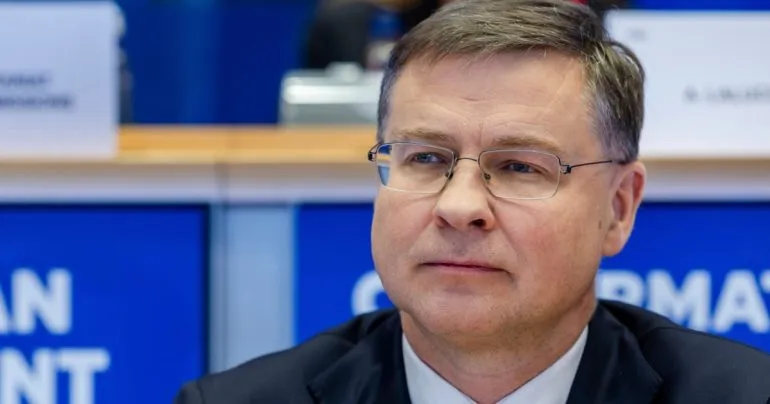
The European Commission plans to use analytical data from the International Monetary Fund to determine the parameters of a future loan to Ukraine, which will be financed from the income generated by frozen Russian assets. This was stated by European Commissioner Valdis Dombrovskis during a meeting of finance and economy ministers from Eurogroup countries in Copenhagen.
This is reported by Kyiv24
Details of the reparations loan and the role of the IMF
According to Dombrovskis, the European Commission is developing an initiative under which Ukraine will receive a loan through the use of the cash balance created from frozen Russian assets. At the same time, Russia’s legal rights to these assets will remain unchanged, as this is not about confiscation, but rather the temporary use of profits from them.
“The European Commission proposes a reparations loan, meaning providing a loan to Ukraine using the cash balance of frozen Russian assets, without fundamentally affecting Russia’s claim to these assets,” he said.
The official clarified that the issue is not currently on the agenda for detailed discussion; however, the European Commission is actively working on defining key parameters, including modalities, timelines, and the volume of this loan.
Frozen Russian assets and the West’s position
Dombrovskis particularly emphasized that it is important to wait for the final assessments from the IMF regarding Ukraine’s needs for the next two years before making a decision on the volume of financial assistance. The completion of this work is now in its final stages.
It is worth noting that Western countries have blocked over 260 billion euros of Russian assets since the beginning of Russia’s full-scale invasion of Ukraine, of which more than 190 billion euros are held in the Belgian depository Euroclear. The European Union has repeatedly discussed the possibility of full confiscation of these assets; however, it has been decided to use only the profits from the frozen funds to support Ukraine.
In the Kremlin, such plans from the West are traditionally referred to as encroachments on state and private property and are regarded as illegal actions.