

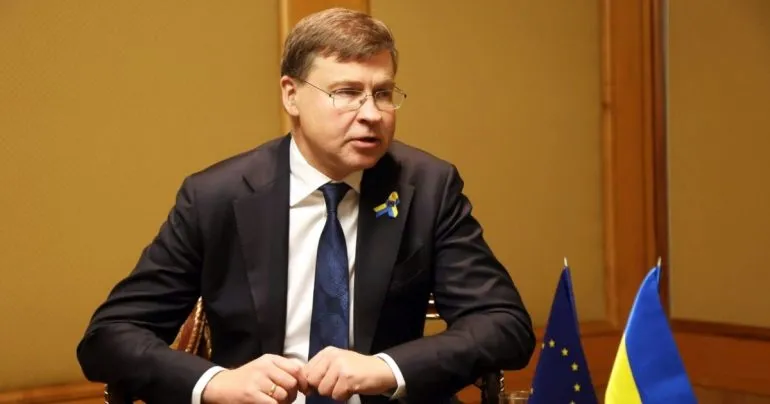
The European Commission is currently not developing a backup plan for financing Ukraine, despite Hungary blocking the approval of a €90 billion loan. This was stated by European Commissioner for Economy Valdis Dombrovskis in an interview on February 23.
This is reported by Kyiv24
Focus on unblocking the decision
According to Dombrovskis, the European Commission is focused on overcoming Hungary’s veto regarding the loan package, rather than seeking alternative funding mechanisms. He emphasized that significant preparatory work has already been done on this package, and Brussels is working on finalizing the necessary documents: the loan agreement, the memorandum of understanding, and the annual financial strategy.
“At this stage, I would not start looking for new alternatives because a lot of work has already been done on this €90 billion package, and significant preparatory work has been carried out,” said Dombrovskis, adding that Brussels is currently focused on unblocking this decision rather than seeking alternative mechanisms.
He underscored that the European Commission continues to prepare all the documentation to begin payments as planned, already at the beginning of April. Dombrovskis also noted that the issue of Hungary’s blockade is not new for the EU, and intensive consultations are currently ongoing with all member states to find an optimal solution.
Political disputes and the stance of countries
The next vote on the approval of the €90 billion loan in the EU Council is scheduled for February 24, during the meeting of ministers for general affairs in Brussels. In addition to Hungary, Slovakia is also blocking the approval of the next package of anti-Russian sanctions and the allocation of credit to Ukraine. They insist on the resumption of Russian oil transportation through the Druzhba pipeline.
Ukrainian officials claim that the Druzhba pipeline was damaged due to Russian shelling at the end of December. Meanwhile, Hungary and Slovakia deny this. Hungarian Foreign Minister Peter Szijjarto stated that there are no physical obstacles to transportation, and the problems are purely political. According to him, Kyiv is pressuring Budapest to unblock negotiations on Ukraine’s EU membership.
Ukrainian Foreign Minister Andriy Sybiha insisted at the EU Council meeting on February 23 that the pipeline is indeed damaged and called on European capitals to direct their ultimatums directly to the Kremlin.
The European Commission confirmed the fact of the destruction of the Druzhba pipeline by Russia and emphasized Ukraine’s obligation to restore it. The timeline for repairs depends on the Ukrainian side.
The European Commission also expects that leaders of all EU countries will adhere to the agreements reached in December and allocate a multi-billion loan to Ukraine. Efforts to persuade Hungary and Slovakia to lift their veto are ongoing at various political levels. Relevant decisions are planned to be made by the fourth anniversary of Russia’s full-scale invasion of Ukraine.