

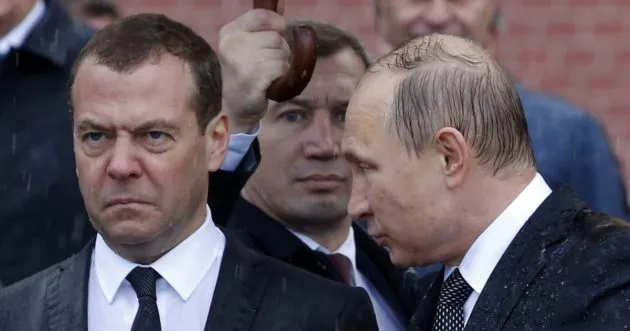
After U.S. President Donald Trump sharply reacted to statements made by former Russian President Dmitry Medvedev, the Kremlin began trying to diminish Medvedev’s public role in the decision-making process. This is the assessment of the American Institute for the Study of War (ISW), which analyzes changes in Russian information policy towards the West.
This is reported by Kyiv24
Clarifying Positions in the Kremlin
ISW experts note that Russian President Vladimir Putin’s spokesman Dmitry Peskov stated there are differing views among Russian officials, including Medvedev, regarding foreign policy. According to Peskov, only Vladimir Putin determines the country’s foreign policy direction, and his position is decisive. Thus, the Kremlin is attempting to distance Putin from Medvedev’s aggressive rhetoric that emerged in response to Trump’s statements.
“Peskov’s attempt to separate Medvedev’s views from Putin’s overlooks how Putin and other high-ranking officials in his inner circle have often used similar nuclear saber-rattling to threaten the West. Medvedev himself does not make decisions regarding Russia’s foreign policy, but ISW continues to believe that his statements are likely part of a coordinated information strategy by the Kremlin… Medvedev’s aggressive statements serve a purpose for Putin, as they prompt the West to perceive Putin’s statements as more moderate and rational in comparison, creating space for Putin to make greater demands or threats,” the ISW experts write.
Reactions to Harsh Statements and the Role of Nuclear Rhetoric
Medvedev’s rhetoric regarding the possibility of using nuclear weapons did not go unanswered. Following his comments about the “Dead Hand” — Russia’s nuclear command and control system — U.S. President Donald Trump announced on TruthSocial the deployment of American nuclear submarines in certain regions. Trump emphasized that the U.S. is prepared for any scenarios and urged caution regarding statements about nuclear weapons.
Peskov also stressed the need for caution concerning nuclear rhetoric, noting that leadership in each country may have differing opinions, but the final word remains with President Putin. He avoided directly answering questions about the Kremlin’s potential influence on Medvedev’s public statements.
On July 29, Trump stated that Russia has 10 days to make progress in ending the war against Ukraine, or the U.S. will impose tariffs and other restrictions. Following this, he expressed disappointment with Putin’s position, while the Kremlin indicated that it took this statement into account, yet the so-called “special military operation” continues.
In response to the U.S. President’s remarks, Dmitry Medvedev stated that this brings Washington closer to war with Russia. He also claimed that “Russia is right in everything and will continue on its path,” referring to the continuation of the war against Ukraine and an anti-Western policy.
After the escalation of statements, Trump clarified his position, explaining that the decision to deploy submarines is a response to nuclear threats from Medvedev: “He (Medvedev – ed.) was talking about nuclear weapons. When you talk about nuclear weapons, we must be ready. And we are fully prepared,” the U.S. President emphasized in a conversation with journalists.