

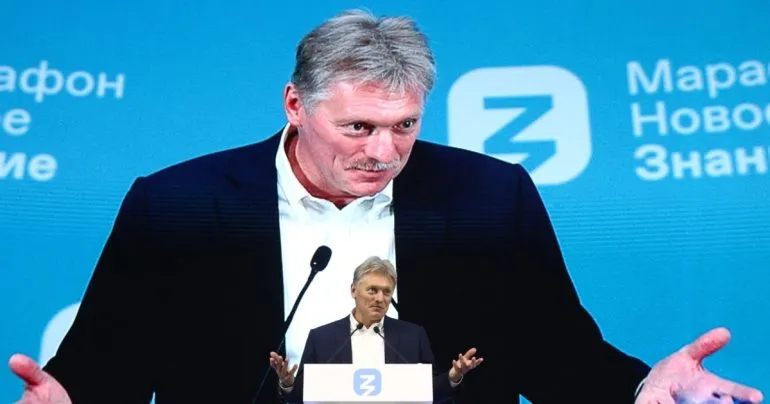
Kremlin spokesman Dmitry Peskov called on Ukrainian President Volodymyr Zelensky on April 1 to make a decision regarding the withdrawal of Ukrainian troops from the territory of Donetsk region. According to Peskov, Zelensky should have made this decision earlier and not delay in fulfilling this demand.
This is reported by Kyiv24
Kremlin’s position and demands on Ukraine
Peskov emphasized that, in his opinion, the withdrawal of the Armed Forces of Ukraine from the Donetsk region could stop the active phase of the war. He stressed that “Zelensky must make a decision today for Ukrainian troops to leave the territory of Donbas. And to leave, to exit beyond the administrative borders of the ‘Donetsk People’s Republic.'”
“Regarding the two months, this is not about two months. Zelensky must make a decision today for Ukrainian troops to leave the territory of Donbas. And to leave, to exit beyond the administrative borders of the ‘Donetsk People’s Republic,'” Peskov said.
At the same time, according to a statement by Volodymyr Zelensky on March 31, Russia demands that Ukraine withdraw its troops from the Donetsk region within two months. The president stated that the Russian side threatens to seize eastern Ukraine and Donbas during this time if Ukrainian forces do not leave these territories, and then the conditions for negotiations will worsen for Ukraine.
ISW’s assessment of the situation at the front
The American Institute for the Study of War (ISW) noted after Zelensky’s statement that the advance of Russian troops on Ukrainian territory has significantly slowed down. Analysts emphasized that Ukrainian defenders have been successfully repelling enemy attacks on various fronts for a considerable time.
ISW points out that, as of the end of March 2026, “significant Russian gains on the front, let alone a complete victory, are not inevitable.” The last six months (from October 2025 to March 2026) have been challenging for the Russian army: Ukrainian counterattacks, medium-range strikes, restrictions on Russia’s use of Starlink satellites in occupied territories, and attempts to block Telegram have only exacerbated problems within the aggressor country’s armed forces.
Experts calculated that the average speed of Russian troop advancement in 2026 is 5.5 square kilometers per day, which is almost half of what it was during the same period in 2025 (11.06 square kilometers per day).
ISW believes that the Kremlin is deliberately creating a “false sense of urgency,” trying to force Ukraine to concede the unoccupied part of the Donetsk region, which Russian troops have failed to control on the battlefield.