

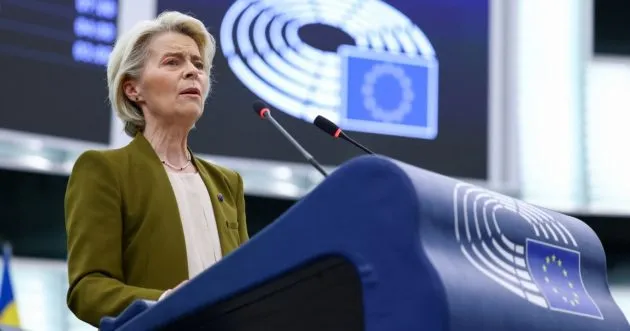
The European Union has begun work on a new, 19th sanctions package against the Russian Federation. One of the key innovations may be the introduction of restrictions not only for Russia itself but also for countries that continue to trade with it. This was stated by European Commission President Ursula von der Leyen during her annual address to the European Parliament.
This is reported by Kyiv24
Focus of sanctions — trading partners and energy
According to von der Leyen, the EU is coordinating its actions with international partners and is paying special attention to accelerating the phase-out of Russian energy resources, combating the activities of the “shadow fleet,” and the influence of third countries that help Russia circumvent existing restrictions.
“We need greater pressure on Russia to bring it to the negotiating table. More sanctions are needed. We are currently working on the 19th package in coordination with our partners. We are particularly focused on the accelerated phase-out of Russian fossil fuels, the shadow fleet, and third countries,” she stated.
These measures, according to the European Commission, are expected to strengthen economic pressure on the Kremlin and curb funding for military aggression against Ukraine.
Reparations loan for Ukraine
The European Commission President also emphasized the need to expand support for Ukraine. She proposed providing Kyiv with a special reparations loan, which would be financed from the revenues of frozen Russian assets. At the same time, von der Leyen stressed that the assets themselves would not be used directly, and the risks would be shared among EU countries.
She added that Ukraine would repay this loan after receiving reparations from Russia. The allocated funds, according to the head of the European Commission, will help both in the short term and will be an important resource for strengthening Ukraine’s defense capabilities in the medium and long term, particularly for financing the Armed Forces of Ukraine.
Meanwhile, against the backdrop of preparing the new sanctions package, Western partners are also discussing additional economic measures. In particular, it was reported that U.S. President Donald Trump proposed that EU countries impose increased import tariffs on Chinese and Indian goods to encourage Beijing and New Delhi to abandon imports of Russian energy resources.