

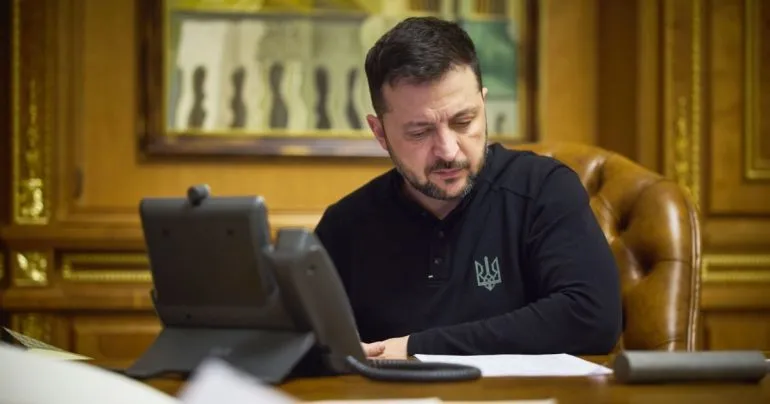
Ukrainian President Volodymyr Zelensky initiated talks with Slovak Prime Minister Robert Fico. One of the key topics of discussion is the restoration of oil transportation through the Druzhba pipeline and bilateral cooperation between the countries.
This is reported by Kyiv24
The Druzhba Pipeline and the Positions of EU Countries
It is noted that during the dialogue, Zelensky invited the Slovak Prime Minister to visit Ukraine to discuss current issues.
“Right now, the President is speaking with Slovak Prime Minister Robert Fico. The President is inviting him to Ukraine to discuss all existing issues.”
Slovak Prime Minister Robert Fico is currently refraining from public comments regarding the conversation with Zelensky.
Hungarian Prime Minister Viktor Orban announced on February 27 the start of consultations with his Slovak counterpart regarding the situation with the Druzhba pipeline. Orban emphasized that Kyiv has not yet resumed oil supplies through this route. The day before, he addressed the President of Ukraine with an open letter and video message, accusing Kyiv of blocking the Druzhba and calling for greater respect for Hungary.
According to media reports, on February 25, Orban appealed to the European Union to organize a fact-finding mission to assess the damage to the Druzhba pipeline on Ukrainian territory. He believes this could facilitate the unblocking of new financial assistance from the EU for Ukraine.
Disputes Surrounding the Restoration of Oil Supplies
Slovakia and Hungary are currently blocking the approval of the twentieth sanctions package against the Russian Federation, as well as the allocation of a multi-billion euro loan to Ukraine, agreed upon by EU leaders in December. Representatives of these countries insist on the restoration of Russian oil transportation through the Druzhba pipeline as a condition for lifting the veto.
Ukrainian officials state that the pipeline was damaged due to Russian shelling at the end of January. Meanwhile, representatives from Hungary and Slovakia deny these claims.
On February 23, representatives of the European Commission confirmed that “Russia has destroyed the Druzhba pipeline,” but emphasized Ukraine’s obligations to carry out repairs. The timeline for completion depends on the Ukrainian side.
Following the onset of full-scale aggression, the EU banned the import of Russian oil. However, exceptions were made for Hungary, Slovakia, and Austria, as these countries are landlocked and depend on oil supplies through the Druzhba pipeline. Austria, however, has been able to diversify its sources of imports.
The Druzhba pipeline transits through Ukrainian territory and facilitates the transportation of Russian oil to Europe, primarily to Hungary and Slovakia.
According to a study by the Finnish Center for Research on Energy and Clean Air (CREA) and the Bulgarian Center for the Study of Democracy (CSD), the import of Russian crude oil to Hungary and Slovakia in 2022–2024 has brought over 5.4 billion euros to the Russian Federation. This is equivalent to the cost of approximately 1,800 Iskander-M ballistic missiles.