

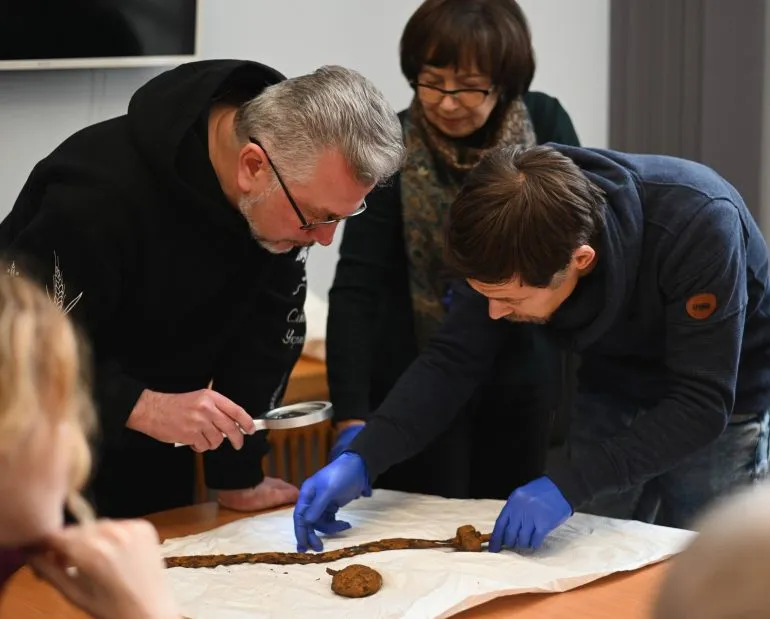
The National Museum of History of Ukraine has received a unique exhibit – an ancient sword dating back to the 10th–11th century, found near Radomyshl in the Zhytomyr region.
This is reported by Kyiv24
Historical Value of the Sword and Its Origin
It is known that the sword was donated to the museum by Viktor Moshchenko and his daughter Natalia. In addition to the sword, two axes were also added to the collection, which were accidentally found near the city of Radomyshl. The exhibit holds special historical significance, as similar weapons were used by the Varangian troops of the Kyiv princes. The territory of modern Radomyshl was historically known as Mychesk or Mykhorod and was one of the fortified cities of the Drevlians – an East Slavic tribe with a developed statehood and economy.
“On the eve of Christmas, our museum received an unexpected gift – Viktor Moshchenko and his daughter Natalia brought an ancient sword, accidentally found near Radomyshl, along with two axes. This exceptional and rare sword dates back to the second half of the 10th century – the beginning of the 11th century. Such swords were used by the Varangian troops of the Kyiv princes, and the fact that it was found near Radomyshl is not coincidental; this discovery is linked to the tragic pages of our land’s history,” the statement reads.
At that time, Scandinavian troops, having established themselves in Kyiv and gained control over the Middle Dnieper, began their expansion into the lands of the Drevlians. The first campaign against the Drevlians was led by Prince Oleg of Kyiv in 884, and his successor Igor was killed while collecting tribute. The Drevlians were finally subdued by Princess Olga in 946, when she burned down the capital Iskorosten (now Korosten).
Features of the Artifact and Expert Assessments
Restorer of the National Museum of History of Ukraine Yuriy But emphasized the uniqueness of the sword: it has been preserved along with a butt – a bronze end of the scabbard, decorated with silver inlay. The ends of the hilt and the cross-guard are also well-preserved, featuring individual ornamentation. The sword displays crosses, and its covering is made of silver and copper.
Archaeologist Serhiy Didenko noted that this is a rare case where the exact location of the artifact is known. The presence of the scabbard suggests that the sword comes from a burial, likely from a plundered mound.