

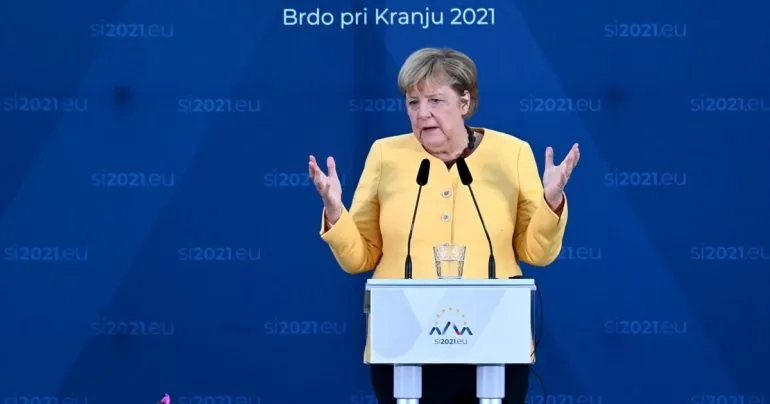
Estonian officials have expressed sharp criticism of former German Chancellor Angela Merkel following her comments regarding the reasons for Russia’s full-scale war against Ukraine.
This is reported by Kyiv24
Criticism from Estonian Politicians
On October 6, Marko Mikhelson, chairman of the Estonian Parliament’s Foreign Affairs Committee, stated that the former chancellor had reached “a new and, unfortunately, very low point: blaming the Baltic states and Poland for provoking Russia’s imperial war.”
“Unfortunately, this casts a shadow over her entire tenure as Chancellor of Germany. I won’t even mention ‘Nord Stream’ here,” Mikhelson added.
Estonian Foreign Minister Margus Tsahkna raised the issue of the reasons for the war, emphasizing that the blame for the aggression lies solely with Russia. According to him, the main reason for the war is that Moscow has been unable to come to terms with the collapse of the Soviet Union and harbors imperial ambitions. “Only Russia is to blame for this aggression,” Tsahkna stressed.
Merkel’s Statements and Media Reaction
It is worth recalling that Angela Merkel, in her interview with the Hungarian publication Partizan, mentioned that towards the end of her term, she sought to create a new format for direct negotiations between the European Union and Vladimir Putin. She noted that she “felt that he no longer took the Minsk agreements seriously.”
According to Merkel, some countries, including the Baltic states and Poland, opposed such an initiative, fearing that a common policy towards Russia could not be developed. She emphasized that her goal was to establish a unified EU position on relations with Moscow.
Following the release of this interview, several media outlets published interpretations suggesting that Merkel allegedly placed the blame for the start of the war on the Baltic states and Poland.
Merkel, who led the German government from 2005 to 2021, has repeatedly faced criticism for her policy towards Russia, particularly regarding the construction of the controversial Nord Stream 2 gas pipeline between Russia and Germany.
In her autobiography, the former chancellor also justified her decision not to support Ukraine’s NATO membership perspective at the Bucharest summit in 2008, despite remarks that this step could have prevented further Russian aggression.