

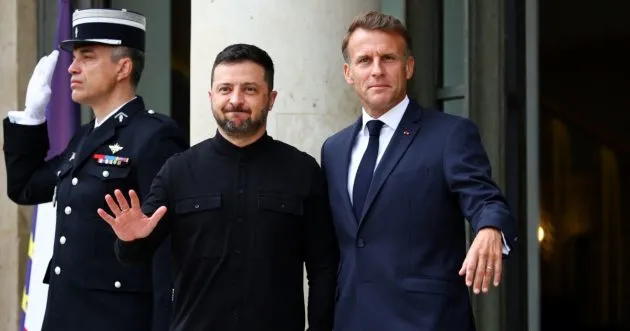
A large-scale meeting of representatives from about 30 Western countries took place in Paris, where they discussed the provision of long-term security guarantees for Ukraine following a potential peace agreement with Russia. Ukraine was represented at the negotiations by the head of the President’s Office Andriy Yermak and the Secretary of the National Security and Defense Council Rustem Umerov. Among the participants were the special envoy of U.S. President Donald Trump, Steve Witkoff, the national security advisor to the Prime Minister of the United Kingdom, Jonathan Powell, the diplomatic advisor to the President of France, Emmanuel Bonne, the national security advisor to the Chancellor of Germany, Günther Sautter, and the diplomatic advisor to the head of the Italian Council of Ministers, Fabrizio Saggio.
This is reported by Kyiv24
Discussion on Security Guarantees and Military Support
During the negotiations, the main focus was on the practical implementation of the agreements reached by the leaders regarding security guarantees for Ukraine. Discussions included effective protection in the air, at sea, on land, and in cyberspace. Issues regarding the strengthening of sanctions against Russia, the return of Ukrainian prisoners, and children forcibly taken by the Russian Federation were also raised. Participants emphasized the importance of coordinating positions to achieve a sustainable and just peace for Ukraine.
“The main task is the practical implementation of the agreements reached by the leaders regarding security guarantees for Ukraine. They must be strong and effective in the air, at sea, and on land, as well as in cyberspace. We also discussed strengthening sanctions, the return of Ukrainian prisoners, and the children abducted by Russia. We continue to coordinate our positions to bring about a sustainable and just peace for Ukraine,” Yermak wrote on Telegram on September 4.
Participation of Western Leaders and the U.S. Position
The meeting was attended by the Presidents of France and Ukraine, as well as the leaders of Poland, Denmark, Finland, the Netherlands, Belgium, the heads of the European Commission and the Council of the EU. The online format included the Secretary General of NATO, leaders from the United Kingdom, Norway, Canada, Spain, Japan, and most European countries. Austria was represented by its Foreign Minister. Among the representatives outside the EU were leaders from New Zealand, Australia, Montenegro, Albania, the Vice President of Turkey, and the Foreign Minister of Iceland. Leaders from Hungary, Slovakia, and Malta were not present.
U.S. President Donald Trump previously emphasized that European countries must take on a larger share of the responsibility for guarantees for Ukraine, while Washington is likely to focus on air support. He also plans to hold talks with the Ukrainian leader after the conclusion of the Paris meeting, although details of potential U.S. support are currently not disclosed. Trump’s special envoy, Steve Witkoff, was partially present at the meeting, addressed the participants, and then left the meeting according to a prior plan for other negotiations.
NATO Secretary General Mark Rutte expressed hope that clarity regarding the collective actions of allies would be achieved soon and that it would be determined what guarantees the U.S. can provide to enhance support for Ukraine. At the same time, the role of the U.S. remains crucial for the continued effectiveness of the “Coalition of the Willing,” which mainly includes European countries, as well as Canada, Australia, and Japan.
Russia, for its part, rejected the idea of deploying European troops on Ukrainian territory, and Vladimir Putin once again threatened to use force if a peace agreement acceptable to Moscow is not reached.