

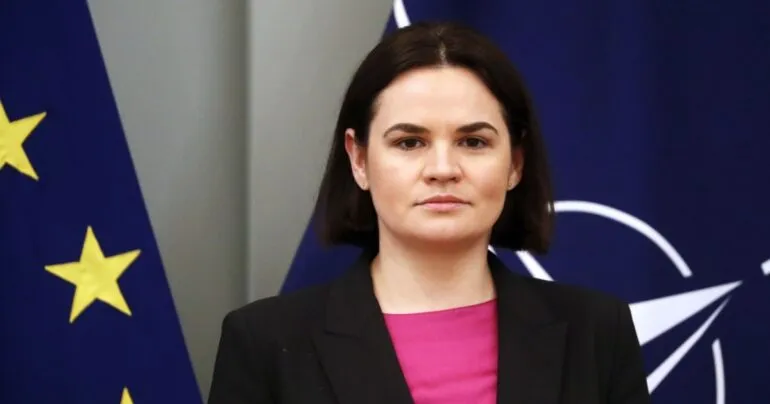
Svetlana Tihanovskaya, the leader of the democratic forces in Belarus, is convinced that socio-political changes in Russia may start precisely after transformations in Belarus. In her opinion, the current retention of power by Alexander Lukashenko’s government is largely ensured by political and economic support from the Kremlin.
This is reported by Kyiv24
The potential of Belarusian society and the influence of the opposition
In her interview, Tihanovskaya emphasized that the assertion that without changes in Russia there will be no changes in Belarus is incorrect. She believes that it is the Belarusian society, characterized by unity and a lack of imperial ambitions, that can serve as a catalyst for change in the neighboring state. She also highlighted the desire of Belarusians to live in good neighborliness with other countries and noted that Belarusian society is currently more consolidated.
“But we must understand that this position, that as long as nothing changes in Russia, nothing will change in Belarus either, is wrong! Because I am confident that changes in Russia can begin with changes in Belarus, because our nation is more united, we do not have these imperial ambitions,” she said in an interview with Radio Liberty.
Challenges for the Belarusian opposition and the role of propaganda
Tihanovskaya noted that the Belarusian opposition faces a powerful propaganda machine of Lukashenko’s regime, which is reinforced by Russian information narratives. She responded to accusations of disunity and detachment of the opposition, emphasizing the importance of maintaining unity and coordination among political actors even six years after the 2020 revolution.
Svetlana Tihanovskaya is confident that investments in Belarusian politics will contribute not only to internal changes but also provide a push for changes in the Russian Federation. She stressed that it is very important for Belarusians to remain united in opposing dictatorship and in interacting with international partners.
Alexander Lukashenko has been in power in Belarus for almost 31 years, starting from July 1994. His last inauguration took place in March 2025, during which he drew parallels between the victory of the USSR in World War II and the suppression of protests in 2020.