

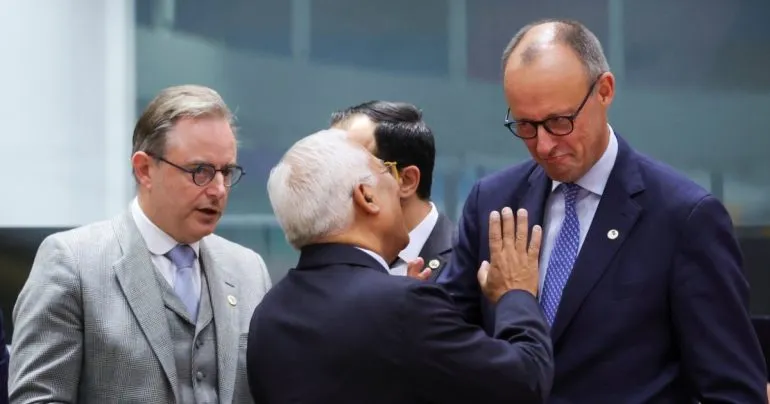
European Union leaders at the summit in Brussels on October 23 were unable to reach a final decision regarding the provision of reparations loans to Ukraine from frozen assets of the Russian Federation. This issue has been postponed to the next summit, and the content of the adopted conclusions has become significantly less specific compared to previous drafts.
This is reported by Kyiv24
Details of the Discussion and Member States’ Positions
Previous versions of the summit conclusions included a direct call for the European Commission to develop a legal proposal for using frozen Russian assets to financially support Ukraine. It was suggested that these actions be carried out in accordance with EU law, international law, and the principles of solidarity and fair distribution of risks among EU countries.
In the final version, this provision was removed— the European Commission is merely invited to “present options for financial support” for Ukraine in the coming years, without specific mention of Russian assets.
Disputes and Conditions of Individual Countries
Before the summit began, the Prime Minister of Belgium put forward a number of conditions that needed to be considered in the decision-making process. Belgium insisted on receiving clear legal clarifications from the European Commission regarding possible support mechanisms without direct confiscation of Russian assets, seeking to avoid legal risks.
As a result, the summit conclusions contained a more general statement, without specifying particular sources of funding.
“The European Council commits to addressing Ukraine’s urgent financial needs for 2026–2027, including support for its military and defense efforts,” the document states.
Additionally, the European Commission was urged to continue working on this issue and prepare options for which EU leaders will return at the next summit.
The conclusions also reiterated a previously approved position: according to EU law, Russian assets must remain frozen until Russia ceases its aggression against Ukraine and compensates for the damages caused. These conclusions were supported by 26 out of 27 EU member states, while Hungary traditionally abstained from support.
President of the European Council António Costa emphasized after the summit that the EU remains committed to supporting Ukraine in addressing its most urgent financial needs, including military and defense assistance, and stressed the necessity of an immediate cessation of the war by Russia.