

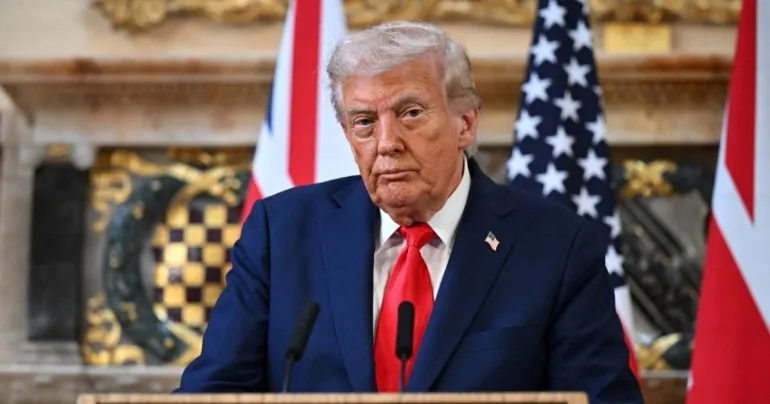
During a joint press conference with British Prime Minister Keir Starmer on September 18, U.S. President Donald Trump expressed his dissatisfaction that some European Union countries have not stopped buying oil from the Russian Federation, despite his own efforts to halt such relations.
This is reported by Kyiv24
“If the price of oil falls, it’s very simple – Russia will seek a settlement (in the war it is waging against Ukraine – ed.). And the price of oil has significantly decreased, you know, we have lowered it a lot. We drilled and produced more oil than anyone else in the world. We did a lot. But it was disappointing to see this. And the Prime Minister was also disappointed to see this. And it wasn’t him, but other countries. And this cannot be done. It’s an unfair game with the United States, and we cannot allow this,” said Donald Trump.
Response from U.S. and U.K. Leaders
Donald Trump emphasized that he is ready to take additional measures, but not when the countries he is fighting for continue to purchase oil from Russia. He stressed the need for fair cooperation and support between the U.S. and its European partners.
For his part, British Prime Minister Keir Starmer also identified the purchase of energy resources from Russia as a “challenge for Europe.” He noted that some European countries remain overly dependent on Russian energy and called for a review of energy policy approaches. Starmer highlighted the importance of expanding sanctions against the Kremlin, which have already been repeatedly implemented in conjunction with Europe and the U.S.
Situation with Russian Oil Imports to the EU
Despite calls for increased energy independence, the leaders did not name specific countries that continue to import oil from Russia. However, among the largest buyers of Russian oil within the European Union are Slovakia and Hungary. Both countries receive oil through the Druzhba pipeline, which transits through Ukraine.
According to a study by the Finnish Centre for Research on Energy and Clean Air (CREA) and the Bulgarian Centre for the Study of Democracy (CSD), from 2022 to 2024, imports of Russian crude oil to Slovakia and Hungary brought the Kremlin’s budget approximately 5.4 billion euros. This amount is comparable to the cost of about 1,800 Iskander-M ballistic missiles.