

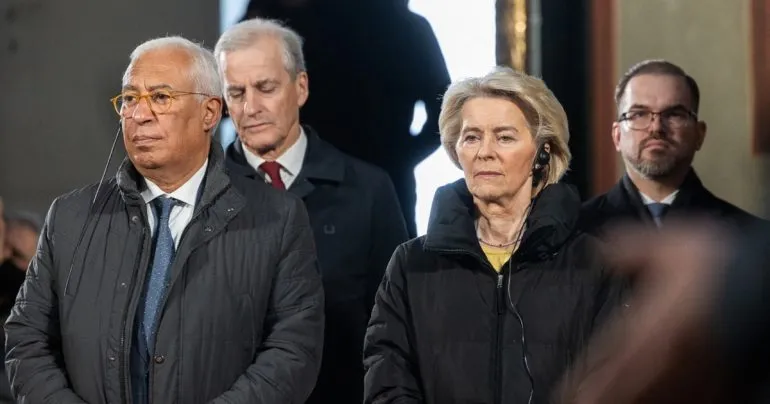
The President of the European Council, António Costa, announced an agreement with Ukraine to assess the time required to restore oil transit through the Druzhba pipeline. According to him, this issue falls within the competence of the European Union, as it concerns relations between a member state and a third country.
This is reported by Kyiv24
“When an EU member state has issues with a third country, it is the EU that needs to address those matters. That is exactly what we have been doing regarding this pipeline. We agreed that Ukraine will conduct an assessment in the coming days to determine how long it will take to restore the pipeline,” Costa said.
Alternatives for Hungary and the EU’s Position
António Costa also noted that there are alternative routes for oil supply to Hungary, including through Croatia, Slovakia, and Serbia. He emphasized that there are other territories that could be involved in transportation, but did not specify which territories he was referring to.
The President of the Euro Council highlighted the need for all EU members to adhere to the principles of fair and transparent cooperation. He stressed that after a decision is agreed upon by the European Council, all countries must work together to implement it, and none of them has the right to block or halt this process.
Costa reported that he had addressed Hungarian Prime Minister Viktor Orbán regarding the violation of the principle of fair cooperation and urged Hungary to immediately engage in the implementation of the approved decisions. He also called on the European Commission to find ways to ensure their execution.
Positions of the Parties: Ukraine, Hungary, and the European Union
European Commission President Ursula von der Leyen emphasized that the decision to provide a loan to Ukraine has already been approved and will be implemented in any way possible. However, European ministers in Brussels were unable to convince Hungary and Slovakia to abandon their intentions to block Ukraine due to delays in restoring the pipeline.
Slovakia and Hungary are currently blocking the adoption of the 20th sanctions package against Russia, as well as the allocation of a multi-billion euro loan to Ukraine, which EU leaders agreed upon back in December. These countries promise not to lift their veto until the transportation of Russian oil through Druzhba is restored.
Ukrainian officials claim that the pipeline was damaged due to Russian shelling at the end of January. Meanwhile, representatives from Hungary and Slovakia deny this information. On February 23, Hungarian Foreign Minister Péter Szijjártó stated that there are no physical obstacles to oil supply and emphasized the political nature of the problem. He believes that Kyiv is trying to stimulate the unblocking of negotiations regarding Ukraine’s EU membership.
Ukrainian Foreign Minister Andrii Sybiha, during a meeting of the EU Council on February 23, emphasized that the pipeline is damaged and called on his Hungarian and Slovak colleagues to address their ultimatums to the “Kremlin.”
Since the onset of full-scale aggression, the EU has banned the import of Russian oil; however, Hungary, Slovakia, and Austria were granted a postponement due to their lack of seaports, which makes them dependent on supplies through the Druzhba pipeline.
The Druzhba pipeline transits through Ukrainian territory and facilitates the transportation of Russian oil to Europe, primarily to Hungary and Slovakia.
According to the Finnish Center for Research on Energy and Clean Air (CREA) and the Bulgarian Center for the Study of Democracy (CSD), from 2022 to 2024, the import of Russian crude oil to Hungary and Slovakia has brought the Kremlin 5.4 billion euros in revenue, equivalent to the cost of 1,800 Iskander-M ballistic missiles.