

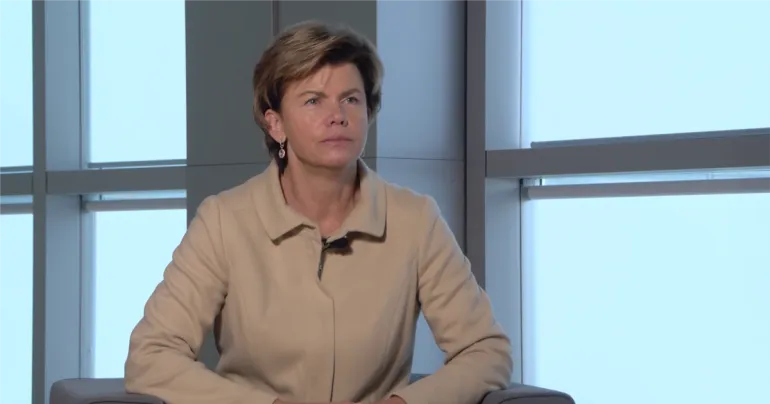
The Latvian Foreign Minister Baiba Braže discussed the importance of establishing an estimated date for Ukraine’s accession to the European Union in an interview. According to her, such a date once helped Latvia mobilize efforts on its path to EU membership.
This is reported by Kyiv24
Estimated Date as a Stimulus for Reforms
Baiba Braže emphasized that determining an approximate date is not only a symbolic step but also a powerful stimulus for implementing reforms. She noted that while the date may change, its existence helps focus attention on preparing the legislative framework, creating appropriate institutions, and adapting society and business to EU standards.
“This helps mobilize efforts. This date may come sooner or later, but it is important to have a legislative process for adopting the entire acquis (the body of EU legislation, norms, standards, and rules – ed.), to create institutions for its implementation, and to prepare society and business,” Braže stressed.
The official highlighted that approaching EU membership requires extensive practical work, including aligning various sectors of the economy, such as agriculture and public services, with EU standards. This complicates the realization of the idea to announce a specific date for Ukraine’s accession to the European Union, which was previously suggested by President Volodymyr Zelensky.
Status of Negotiations and Challenges on the Path to Membership
Braže noted that the main difficulty lies not in determining the date but in fulfilling a large volume of preparatory measures. She also pointed out that the decision regarding a specific date for Ukraine’s EU membership will be made by the EU itself, and she refrained from predicting the possibility of accession by 2027, considering political obstacles, particularly the blockage from Hungary.
At the same time, the minister emphasized that Ukraine is already undertaking significant technical work aimed at preparing for accession negotiations, particularly regarding compliance with the so-called Copenhagen criteria — democracy, human rights, and the functioning of a market economy. In her opinion, this will allow Ukraine to advance quickly after the formal start of negotiations.
On the anniversary of the full-scale invasion by Russia, President Volodymyr Zelensky stated that defining a clear date for Ukraine’s EU membership should become part of the security guarantees in future peace negotiations. Zelensky stressed that the absence of such a date could allow the Russian president to block this process for decades.
EU Commissioner for Enlargement Olivér Várhelyi confirmed during the Munich Security Conference that Ukraine’s EU membership is viewed as an important component of security guarantees and could be a subject of negotiations in the context of a future peace agreement. Among the points of the 20-item peace proposal being discussed between Ukraine, the USA, and Russia, there is also the prospect of Ukraine’s EU membership, which, according to some assessments, may be linked to the year 2027.
However, there is skepticism within the EU regarding this date. Olivér Várhelyi stated at the end of January that he cannot guarantee Ukraine’s accession to the EU by 2027, despite significant progress in negotiations. German Chancellor Friedrich Merz also noted that Ukraine’s EU membership in the near future is unlikely.