
The President of Ukraine, Volodymyr Zelensky, announced the intention to expand the geography and range of Ukrainian strikes on targets deep within the Russian Federation. According to the head of state, these actions are aimed at weakening the military-industrial complex, logistics routes, and oil exports of Russia.
This is reported by Kyiv24
Ukrainian strikes on Russian oil refineries
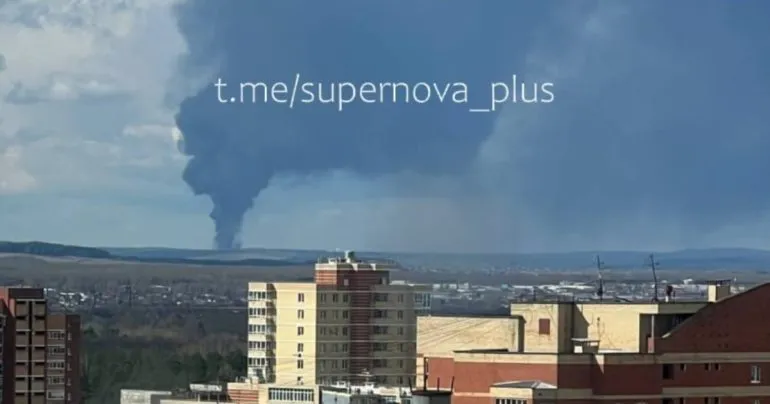
On April 29, an attack by drones was recorded in the Perm Krai of Russia, located approximately 1500 kilometers from the Ukrainian border. Local residents reported on social media about drones heading towards the oil refinery: photos and videos showing a large column of smoke were shared online. The governor of Perm Krai, Dmitry Mahonin, reported a drone’s “arrival” at one of the industrial sites in the Perm municipal district, resulting in a fire. Workers were evacuated, and there were no casualties. The official authorities of Russia did not disclose details regarding the consequences of the strike, and the Ukrainian side did not comment on the situation.
“The report by Major General Yevgeny Khmara regarding our long-range sanctions – a new stage in the use of Ukrainian weapons to limit the potential of the Russian war. I am grateful to the guys from the SBU for their accuracy. The straight-line distance is over 1500 km. We will increase the corresponding distances, and these are entirely justifiable Ukrainian responses to Russian terror,” Zelensky noted.
Environmental consequences and Kremlin reaction
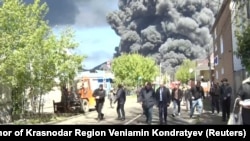
On the night of April 28, Ukrainian forces struck the Tuapse oil refinery in the Krasnodar Krai of Russia. This is the third attack on this facility in April: earlier strikes were recorded on the 16th and 20th. After the strike on April 20, a fire burned at the refinery for several days, resulting in a significant oil spill into the sea, and the city experienced several instances of so-called “oil rain.” Following the latest attack, the authorities of Tuapse declared a state of emergency, and the city experienced disruptions in water supply.
The President of Russia, Vladimir Putin, acknowledged that the latest fire at the oil refinery in Tuapse could have environmental consequences but stated that “there is no serious threat.” At the same time, he referred to the Ukrainian strike on the refinery in Tuapse as “terrorism.”
Experts from the American Institute for the Study of War (ISW) noted that the consequences of the attacks by the Armed Forces of Ukraine on the Tuapse refinery were so significant that they provoked a personal reaction from Putin. Analysts emphasize that in most cases, the Kremlin ignores public statements regarding strikes on Russia’s oil infrastructure.
According to ISW, Ukraine is increasing the intensity of attacks on Russian oil infrastructure, while Russia is trying to take advantage of the situation in global energy markets to increase profits from exports and finance the war against Ukraine. It is expected that Ukrainian forces will continue to use significant distances to strike strategic targets in the rear of Russia, particularly due to the growth in drone production.
Since the beginning of the full-scale invasion of Russia, various facilities on the territory of Russia have regularly been subjected to air strikes, primarily oil refineries in 2024 and 2025. Occupation forces’ facilities in temporarily occupied territories of Ukraine are also being targeted.
The General Staff of the Armed Forces of Ukraine has repeatedly confirmed such attacks, emphasizing that the Defense Forces of Ukraine are “systematically implementing measures aimed at reducing the combat potential of the Russian occupation forces, as well as forcing Russia to cease its armed aggression against Ukraine.”