

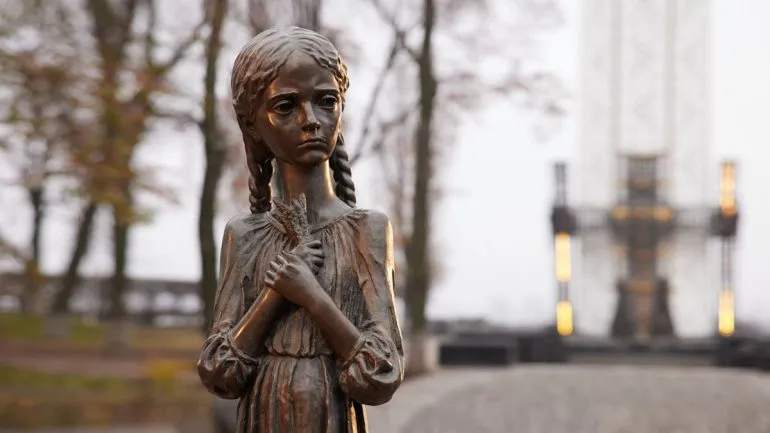
Every year on the fourth Saturday of November, Ukraine honors the memory of the victims of the Holodomors, recalling the tragic events of the 20th century.
This is reported by Kyiv24
Three Waves of Holodomor: Causes and Consequences
The Ukrainian people experienced three major famines in the 20th century: the famines of 1921–1923, 1932–1933, and the famine of 1946–1947. The most horrific among them was the Holodomor of 1932–1933, recognized as a genocide of the Ukrainian people orchestrated by the Soviet authorities. The roots of this tragedy lay in forced collectivization, the “dekulakization” of wealthy peasants, harsh grain procurement policies, and widespread terror in rural areas.
It is known that the policy of the Stalinist regime towards the Ukrainian peasantry was aimed at total suppression of resistance and the destruction of the social and economic foundation of the nation.
“The terror of hunger that operated in Ukraine for 22 months was a conscious and deliberate policy of the Stalinist government, the strategy and tactics of which were implemented starting in 1928.”
Following mass repressions against the intelligentsia and the clergy, the next target of the authorities became the peasants.
Course of Events and Scale of the Tragedy
The beginning of the Holodomor was marked by the resolution of the Central Committee of the Communist Party (Bolsheviks) of Ukraine on November 18, 1932, which stipulated severe penalties for failing to meet grain procurement plans — the so-called “natural fines” involving the confiscation of meat, potatoes, lard, and other products. On the same day, a document was adopted allowing the seizure of grain from peasants under accusations of “counter-revolutionary crimes.”
Just a few days later, on November 26, 1932, the People’s Commissar of Justice and the Attorney General of the Ukrainian SSR issued an order emphasizing that repression was a key method for overcoming resistance during grain procurement. By December 1932, trade in food products was banned in 82 districts of Ukraine, and the supply of industrial goods was halted. At the beginning of 1933, the authorities prohibited peasants from leaving the borders of the famine-stricken Ukraine, depriving them of even minimal chances for salvation.
People had to survive by eating substitutes: corn cobs, husks, straw, rotten vegetables, tree bark, and leaves. According to official data, around four million Ukrainians fell victim to the terror of hunger.
The Law “On the Holodomor of 1932–1933 in Ukraine” from 2006 clearly defines these events as an act of genocide against the Ukrainian people. Public denial of the Holodomor is recognized as an affront to the memory of the deceased and a humiliation of the nation’s dignity. In 2010, the Kyiv Court of Appeals found the leaders of the Soviet government guilty of organizing the Holodomor: Joseph Stalin, Vyacheslav Molotov, Lazar Kaganovich, Pavel Postyshev, Stanislav Kosior, Vlas Chubar, and Mikhail Khataevich.
Today, the Holodomor of 1932–1933 is recognized as genocide against the Ukrainian people at the state level in 29 countries and at the municipal level in another 11. These events have also been officially recognized as genocide by international organizations, including the Parliamentary Assembly of the Council of Europe, the European Parliament, and the Baltic Assembly.
Traditionally, on this day, Ukrainian families light a candle of remembrance at home in honor of those who perished from the man-made famine. At 4:00 PM, a nationwide moment of silence is observed across the country, and memorial events continue in cities and villages.