

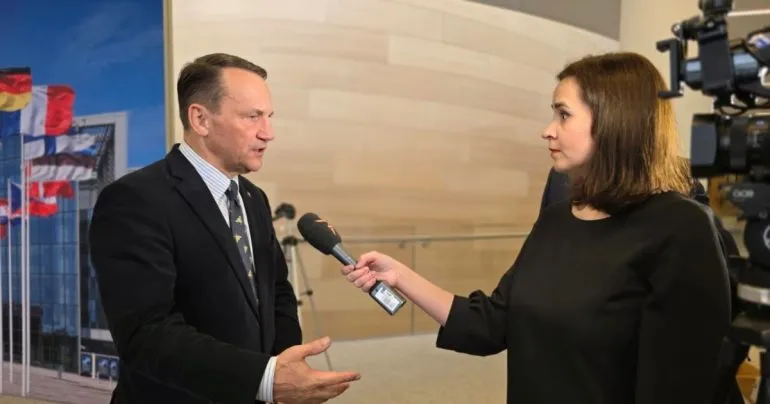
Polish Foreign Minister Radek Sikorski expressed skepticism about the quick achievement of a peace agreement or ceasefire in Russia’s war against Ukraine, despite support for peace initiatives from the United States. The diplomat made this statement during a comment in Brussels.
This is reported by Kyiv24
Polish Government’s Position on Negotiations
According to Sikorski, he supports the efforts of American allies and Ukrainian negotiators, but he does not believe that Russian leader Vladimir Putin is currently ready for substantial compromises that would allow for an agreement with Ukraine. The minister emphasized the need to intensify pressure on the Russian leadership and provide more support to Ukraine.
“I am keeping my fingers crossed for American allies and, of course, for Ukrainian negotiators, but personally, I am not convinced that Putin is ready to make sufficient compromises for Ukraine to reach an agreement. We need to increase pressure on Putin and provide more assistance to Ukraine,” Sikorski noted.
In response to a question about the willingness of Western partners to exert greater pressure on the Russian leadership, Sikorski confirmed the allies’ commitment to adhere to a common plan and not to lose determination, stressing that only Ukrainians have the right to fatigue in this war.
Reparations and Prospects for Future Support for Ukraine
The Polish minister emphasized the crucial importance of a multi-billion reparations loan for Ukraine, which should be based on frozen Russian assets. Discussions on this issue are ongoing within the European Union, and a final decision is expected at the EU leaders’ summit in December. Belgium, where these assets are held, has not yet agreed to the relevant initiative.
Sikorski highlighted that a positive decision regarding the reparations loan could convince Putin of Ukraine’s ability to receive financial support over the next two to three years, which could influence the course of the war. At the same time, a refusal to finance could signal to the Kremlin a possible weakening of European support for Ukraine, which, according to the minister, would lead to catastrophic consequences.
Late in the evening on December 2, negotiations between U.S. representatives Steve Witkoff and Jared Kushner and Vladimir Putin regarding possible parameters for a peace agreement between Russia and Ukraine concluded in Moscow. Putin’s assistant Yuri Ushakov reported that a compromise option has not yet been reached, although some American proposals appear acceptable. According to Ushakov, a future meeting between Putin and U.S. President Donald Trump is not planned, but such a possibility will depend on further progress in negotiations.
The Kremlin emphasized that statements about Putin allegedly rejecting the U.S. peace plan are not accurate, and Kremlin spokesman Dmitry Peskov noted that there was a direct exchange of views during which some proposals were accepted and others rejected. He described this as a “normal working process and search for compromise.”