

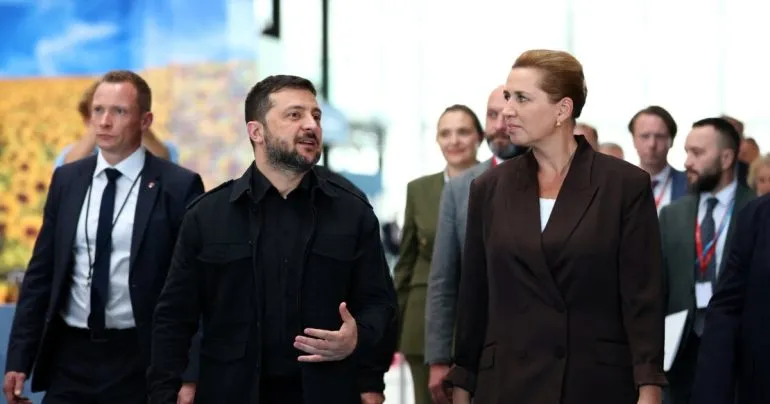
Danish Prime Minister Mette Frederiksen stated that the issue of using frozen assets of the Russian Federation to support Ukraine involves several technical aspects that still need to be resolved. She expressed confidence that these issues can be addressed, as she mentioned during a joint press conference with Ukrainian President Volodymyr Zelensky.
This is reported by Kyiv24
“Regarding the frozen assets, we had fruitful discussions yesterday. There are certain technical issues that need to be resolved. But I am quite confident that we can do this,” she said during the joint press conference with Ukrainian President Volodymyr Zelensky.
European leaders discuss mechanisms for asset transfer
Mette Frederiksen emphasized that she believes it is fair for Russia to compensate for the damages inflicted on Ukraine. At the same time, she noted that there are many unresolved issues surrounding the question of reparations. The Prime Minister is convinced that a solution will be found, as there are no alternative options: the war continues, and peace is only possible with support from Europe. According to her, Ukraine is the first line of defense, and significant funding is needed to ensure its security, so other EU countries must participate in this process.
Before the next meetings, as Frederiksen emphasized, European Union leaders must find solutions to all technical issues in order to achieve a unified position that all 27 member countries will support.
International discussion and legal risks
German Chancellor Friedrich Merz also stated that there is a “strong consensus” among European leaders regarding the use of frozen Russian assets to assist Ukraine. A concrete decision is expected to be made at the next EU summit, which will take place in three weeks.
Currently, around $300 billion of Russian sovereign assets are blocked in Europe. Of these, approximately €190 billion are held in the international depository Euroclear in Belgium, another €30 billion in the United Kingdom, and €19 billion in France.
At the EU leaders’ meeting in Copenhagen, the idea of providing Ukraine with a reparations loan was discussed, but consensus on this issue could not be reached. According to the Financial Times, Belgium insists on sharing the risks among all EU countries and demands legal protection guarantees against potential lawsuits from Moscow. France and Luxembourg also expressed concerns about the legal implications of such an initiative.
The cash amount obtained from bonds of the Russian Central Bank held in Euroclear is approximately €176 billion. These funds are not being returned to Russia due to the sanctions imposed by the EU after the full-scale invasion of Ukraine. The proposed reparations loan mechanism involves transferring these funds to the European Union, which would enter into an individual debt contract with Euroclear at a zero interest rate. Brussels plans to use these funds to provide a loan to Ukraine, which will only be repaid in the event of compensation for damages by Russia. The Kremlin, in turn, criticized this idea, calling it “pure theft.”
In response to the potential seizure of its assets abroad, on September 30, 2025, Russian President Vladimir Putin signed a decree on a new procedure for the sale of federal assets. According to Bloomberg, Russia is prepared to nationalize and quickly sell foreign assets in the event of a threat of their seizure in other countries.