

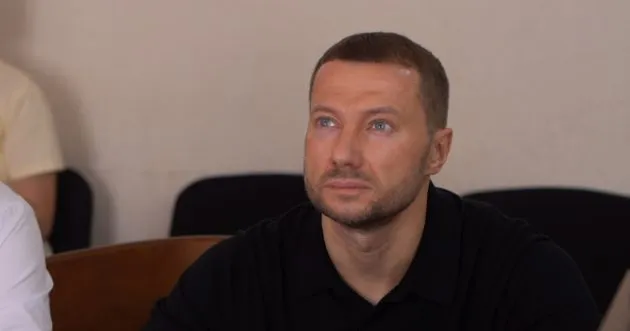
The High Anti-Corruption Court of Ukraine rejected the request of the Specialized Anti-Corruption Prosecutor’s Office on August 11 to temporarily suspend Pavlo Kyrylenko from his duties as head of the Antimonopoly Committee of Ukraine. Kyrylenko is accused of false declaration and illegal enrichment amounting to 72 million hryvnias, which became known after an investigation by journalists.
This is reported by Kyiv24
Arguments of the Parties and the Court’s Decision
The decision was made by a panel of three judges, including Natalia Movchan. Kyrylenko’s defense had previously unsuccessfully filed a motion to recuse her, arguing that there was a potential conflict of interest due to the work of the judge’s husband at the company “Ukrenergo,” whose cases are under consideration by the AMCU. However, the court did not grant this recusal.
Prosecutors from the SAP insisted on Kyrylenko’s suspension, stating that he confirmed in court the possibility of using his position to influence participants in the criminal proceedings through close associates.
“Kyrylenko can influence witnesses in the criminal proceedings and obstruct the judicial process by using his position, which he himself stated during the consideration of the motion to recuse the presiding judge,” said SAP prosecutor Valentina Grebenyuk.
At the same time, prosecutor Grebenyuk noted that the prosecution had previously underestimated the risks of Kyrylenko’s influence on the process.
Pavlo Kyrylenko’s defense opposed his suspension, adding that there is a potential conflict of interest, but that Kyrylenko could be under pressure due to the court case. Kyrylenko himself supported his lawyer’s position, stating that he could be influenced during the consideration of cases regarding “Ukrenergo,” but considered the prosecutor’s request to be unfounded.
Preventive Measures and Circumstances of the Case
The court also considered the issue of preventive measures. Kyrylenko was imposed a number of procedural obligations for two months: he must surrender his foreign passports, not leave the borders of Ukraine, notify of any change of residence, appear in court when summoned, and refrain from communicating with witnesses.
It is known that the bail for Pavlo Kyrylenko in the amount of 30 million hryvnias was provided by the private company “Keramet,” owned by Eduard Mkrtchan. The activities of another company owned by Mkrtchan are currently being investigated by the AMCU for potential anti-competitive actions.
Journalists asked Kyrylenko whether he sees a conflict of interest in the fact that the bail was provided by a company that is also under investigation by the committee. Pavlo Kyrylenko responded that the facts are being distorted and promised to prove this in court.
The criminal proceedings against Kyrylenko were initiated in March 2024. The investigation established that from 2020 to 2023, Kyrylenko’s family acquired real estate and vehicles worth over 70 million hryvnias without having official income for this. Kyrylenko explained that the source of the wealth was family capital obtained from the sale of shares in the “Stirol” plant in the 1990s, but no evidence of this could be found.
After the publication of the journalistic investigation, Kyrylenko declared an apartment in Kyiv of 200 square meters, which is registered in the name of his wife’s grandmother, but did not declare the BMW car used by his wife. On August 28, 2024, the court denied the request to take Kyrylenko into custody and set bail at 30 million hryvnias with the obligation to wear an electronic bracelet.
On June 4, 2025, the court reduced the bail amount to 25 million hryvnias but did not allow travel for business trips abroad. The next day, Kyrylenko’s wife was notified of suspicion of aiding in illegal enrichment and bail was set at 9 million hryvnias, which was later reduced to 242 thousand hryvnias by the appellate chamber.