

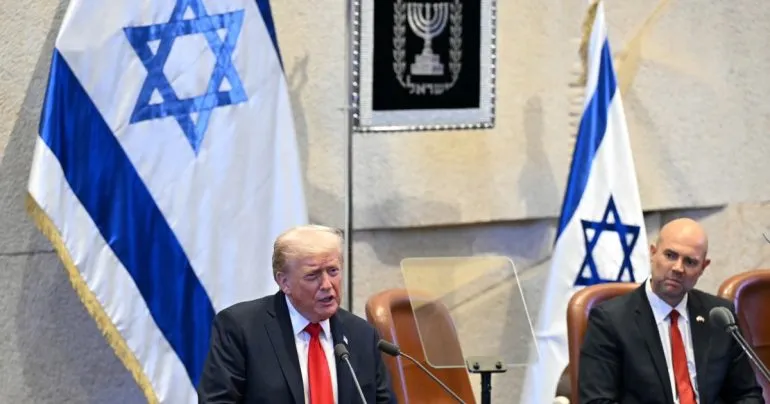
Former U.S. President Donald Trump, speaking at the Knesset in Israel, emphasized his confidence in the possibility of ending Russia’s war against Ukraine. The politician highlighted that resolving this conflict is a completely achievable task, comparing it to previous diplomatic initiatives in the Middle East, which he considers successful.
This is reported by Kyiv24
Trump on Negotiations and the Role of Witkoff
Trump mentioned that, in his opinion, the war in Ukraine would not have started if he had remained in office as President of the United States at the time of Russia’s full-scale invasion. He also pointed out the enormous human losses, which he claims reach seven thousand military personnel each week, calling it a “shame.”
“I thought that this (ending the war in Ukraine – ed.) would be much easier than what we just very successfully did with Israel and many other people. But that was achieved first. We will also achieve this (resolving the war in Ukraine – ed.),” Trump stated from the Israeli parliament.
In his speech, Trump mentioned special representative Steve Witkoff, whom he called a “great negotiator.” In his view, Witkoff managed to establish a lasting connection with Russian President Vladimir Putin, which, according to Trump, is rare among American representatives. He noted that most American delegates would not have been able to negotiate with Putin for as long as Witkoff did.
Details on Negotiations and Russia’s Position
It should be noted that Steve Witkoff had no diplomatic experience prior to his appointment and was not known as a specialist in Russian affairs. It is reported that in August 2025, the German publication Bild stated that during a visit to Moscow, Witkoff may have misinterpreted Putin’s statements regarding the conditions for a ceasefire. In particular, he perceived them as a willingness to make concessions, although in reality, the Russian Federation insisted on maintaining control over four occupied Ukrainian regions, including Kherson and Zaporizhzhia, which remain under Ukrainian control despite being included in the Russian constitution.